Citizen Against His Will: The Man Who Renounced America Twice — Because Once Wasn't Enough
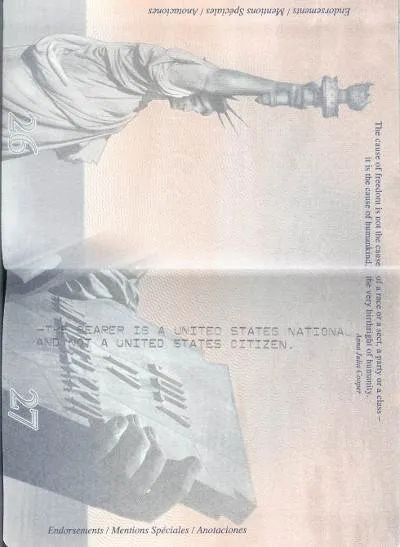
Photo: This is a scan of a public domain work created by the US government., Public domain, via Wikimedia Commons
Citizen Against His Will: The Man Who Renounced America Twice — Because Once Wasn't Enough
Renouncing your American citizenship isn't something you do on a whim. It's a formal legal procedure involving a sworn oath, a consular officer, a stack of paperwork, and a State Department processing fee that currently runs over $2,000. It is, by design, a serious and deliberate act. The government wants to make sure you mean it.
So imagine completing that entire process, walking away confident that you are no longer a U.S. citizen — and then discovering, years later, that the government had quietly given it back.
This is not a hypothetical. It happened. And the story reveals something genuinely unsettling about how federal identity law worked for much of the twentieth century: the machinery was so tangled with contradictions that a person could become American again without signing a single document, without their knowledge, and entirely against their wishes.
The Architecture of Involuntary Citizenship
To understand how this was possible, you need to understand a peculiarity of mid-century American citizenship law. For much of the twentieth century, the United States operated under a legal framework in which certain acts — serving in a foreign military, voting in a foreign election, taking an oath of allegiance to another country — were deemed "expatriating acts" that automatically stripped a person of American citizenship.
But the law also had a mirror image problem. In some cases, particularly for individuals who had been born in the United States or who had derived citizenship through a parent, subsequent legal changes or court interpretations could retroactively restore that citizenship, even after a formal renunciation. The two systems — the one that took citizenship away and the one that gave it back — were not always talking to each other.
The Supreme Court began chipping away at the government's power to strip citizenship involuntarily through a series of decisions in the 1950s and 1960s, most notably Trop v. Dulles (1958) and Afroyim v. Rusk (1967). The court increasingly held that citizenship was a constitutional right that Congress could not simply revoke without genuine voluntary relinquishment. These rulings were intended to protect Americans from losing citizenship unfairly. But they had an unintended side effect: they created legal pathways through which previously renounced citizenship could be retroactively reinstated.
 Photo: Afroyim v. Rusk, via i.ytimg.com
 Photo: Trop v. Dulles, via coverimg-cdn.storyjumper.net
The Double Renunciation
The most documented type of case involving this paradox involved individuals who had renounced citizenship under one legal framework, only to have subsequent court decisions or statutory changes effectively restore what they had deliberately given up. For foreign-born individuals who had naturalized, renounced, and then been swept back in by shifting legal interpretations, the experience was a bureaucratic nightmare.
In at least one formally documented case from the mid-twentieth century, a man who had been born abroad, derived U.S. citizenship through a parent, and subsequently renounced that citizenship through proper legal channels found himself re-categorized as a citizen when a court ruling changed the standards for what constituted a valid renunciation under the circumstances of his original case. He had not applied for anything. He had not signed anything. The government had simply revised its legal interpretation and, in doing so, reclaimed him.
He was required to renounce again. The second renunciation, processed under the newer, more stringent standards established by post-Afroyim case law, finally held.
What the Law Was Actually Saying
The deeper issue this story exposes isn't really about one man's paperwork ordeal. It's about the fundamental tension at the heart of American citizenship law: who owns the legal status of being American — the individual, or the state?
For most of the twentieth century, the answer was uncomfortably ambiguous. The government reserved the right to define, confer, revoke, and — as it turned out — restore citizenship on terms that the individual had no direct control over. A person could explicitly, formally, and irrevocably say "I am not American" and the federal government could look at its own statute books, shrug, and say "actually, you are."
The post-Afroyim legal landscape significantly narrowed this power, establishing that genuine voluntary intent is required for a valid renunciation. But the transition period between the old framework and the new one created a window in which the contradictions were at their most acute — and in which at least some individuals found themselves legally American despite every effort to be otherwise.
The Quiet Machinery
There's something almost philosophically vertiginous about the scenario. Most conversations about citizenship focus on people desperately trying to obtain it — immigrants navigating the naturalization process, asylum seekers fighting deportation, families separated by visa complications. The idea that someone might have to fight to not be a citizen, and lose that fight once before winning it a second time, cuts against every assumption we carry about how national identity works.
The man in this story didn't want to be American. He said so clearly, through the proper legal channels, with full understanding of what he was doing. The government took his paperwork, processed it, and then — without asking — handed it back.
It took him two tries and a shift in constitutional law to finally get the government to take his word for it.
Citizenship, it turns out, isn't always something you choose. Sometimes the paperwork chooses for you.