The Inventor Who Tried to Patent the Universe: How One Man Nearly Owned Gravity Itself

The Most Audacious Patent Application in History
On March 15, 1954, the United States Patent Office received Application Serial Number 417,845: "Method and Apparatus for Gravitational Field Manipulation." The applicant, Harold P. Clemmons of Akron, Ohio, claimed to have invented a device that could harness, control, and redirect gravitational force. If approved, Clemmons would have owned exclusive rights to humanity's relationship with gravity itself.
 Photo: Akron, Ohio, via c8.alamy.com
The truly remarkable part? Patent examiners spent nearly two years seriously considering whether to grant it.
The Suburban Inventor's Cosmic Ambition
Harold Clemmons was exactly the kind of basement inventor that 1950s America loved to celebrate. A former radio repairman turned self-taught physicist, he spent his evenings in a converted garage workshop, surrounded by electromagnetic coils, vacuum tubes, and increasingly elaborate contraptions that neighbors described as "looking like something from Buck Rogers."
Clemmons believed he had discovered what he called "gravitational resonance frequency" — the idea that gravity operated like a radio wave that could be tuned, amplified, or redirected with the right equipment. His patent application included detailed blueprints for a "gravity manipulation chamber" that could theoretically make objects weightless or increase their gravitational pull at will.
The 47-page application read like science fiction, complete with technical diagrams showing how his device could "bend space-time through controlled electromagnetic interference with gravitational field propagation."
The Patent Office Takes It Seriously
What makes this story incredible isn't that someone filed a ridiculous patent — it's that the U.S. Patent Office treated it as a legitimate scientific claim requiring formal evaluation.
Patent Examiner Robert Morrison was assigned to Clemmons' application in April 1954. Morrison, a mechanical engineer with 15 years of experience, later admitted he had "never encountered anything quite like it." The application included mathematical formulas, engineering specifications, and what appeared to be genuine scientific methodology.
Rather than immediately rejecting it as impossible, Morrison began a comprehensive review process that would stretch across multiple departments and involve consultation with government physicists.
The Bureaucratic Black Hole
Clemmons' application created chaos within the Patent Office's classification system. Gravity manipulation didn't fit into any existing category — was it a mechanical device? An electromagnetic apparatus? A theoretical physics concept?
The application bounced between departments for months. The Mechanical Engineering division said it belonged with Electrical. Electrical claimed it was really a Physics matter. Physics argued that since no working prototype existed, it fell under Theoretical Concepts, which didn't actually exist as a patent category.
Meanwhile, Clemmons kept submitting additional documentation. He sent photographs of his workshop equipment, detailed mathematical proofs, and even audio recordings of what he claimed were "gravitational frequency measurements" picked up by his devices.
The Government Gets Interested
By early 1955, Clemmons' patent had attracted attention from some unexpected quarters. The Air Force's Wright-Patterson research facility requested copies of his documentation. The Navy's experimental physics program sent representatives to visit his Ohio workshop.
Suddenly, what had started as a routine patent application became entangled with classified military research into exotic propulsion systems. Cold War paranoia meant that even seemingly impossible inventions deserved investigation — what if the Soviets were working on something similar?
Clemmons found himself signing non-disclosure agreements and submitting to background checks, all for a device that violated fundamental laws of physics.
The Moment Reality Intervened
The patent application's death knell came in December 1955, when the Patent Office finally consulted with Dr. Eugene Wigner, a Nobel Prize-winning physicist at Princeton. Wigner's response was diplomatically devastating: Clemmons' device was "theoretically impossible under current understanding of physical laws" and would require "suspension of gravitational constants throughout the observable universe" to function.
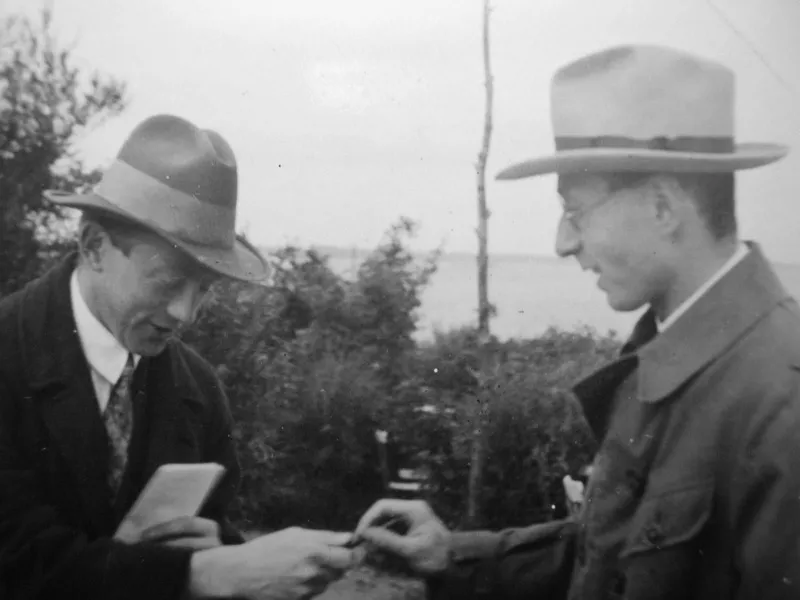 Photo: Dr. Eugene Wigner, via nationalmedals.org
More damning, Wigner's team had actually built a version of Clemmons' device based on his specifications. It did absolutely nothing except consume electricity and make humming noises.
Other Attempts to Own Nature
Clemmons wasn't alone in trying to patent the impossible. Patent Office records from the 1950s reveal dozens of similarly audacious applications:
- Application 428,901: "Method for Controlling Solar Radiation Output" (essentially trying to patent the sun's dimmer switch)
- Application 445,667: "Apparatus for Time Manipulation Through Electromagnetic Field Distortion"
- Application 461,223: "System for Harvesting Atmospheric Electricity During Fair Weather" (attempting to own the sky's electrical potential)
Most remarkably, several of these applications made it through initial review processes before being rejected on scientific grounds.
The Legal Precedent That Almost Was
If Clemmons' patent had been approved, it would have created unprecedented legal questions. Could someone own exclusive rights to a fundamental force of nature? Would using gravity without permission constitute patent infringement? Could the patent holder charge licensing fees to anyone whose existence depended on gravitational attraction — which is to say, everyone?
Patent law experts later called it "the closest America ever came to privatizing physics itself."
The Final Rejection
On February 14, 1956, the Patent Office issued its final rejection of Application 417,845. The 12-page denial letter diplomatically explained that while Clemmons' engineering work showed "considerable technical sophistication," his fundamental premise violated "well-established principles of gravitational mechanics."
Clemmons appealed the decision twice, submitting additional "proof" including testimonials from neighbors who claimed to have witnessed successful gravity manipulation demonstrations in his garage. Both appeals were denied.
The Legacy of Impossible Ambition
Harold Clemmons never got his gravity patent, but his application revealed something fascinating about the intersection of American innovation and bureaucratic process. In a country built on the idea that anyone could invent anything, even the most impossible dreams deserved official consideration.
The Patent Office's willingness to seriously evaluate a claim on gravity itself reflects the optimistic absurdity of 1950s America — a time when the impossible seemed merely improbable, and the line between science fiction and patent application was surprisingly thin.
Clemmons continued inventing until his death in 1987, filing 23 more patents for increasingly exotic devices. None were approved, but patent examiners remember him fondly as the man who almost owned the force that keeps our feet on the ground.