From Shipwreck to Main Street: The Delirious Sailor Who Accidentally Built Oregon
The Storm That Changed Everything
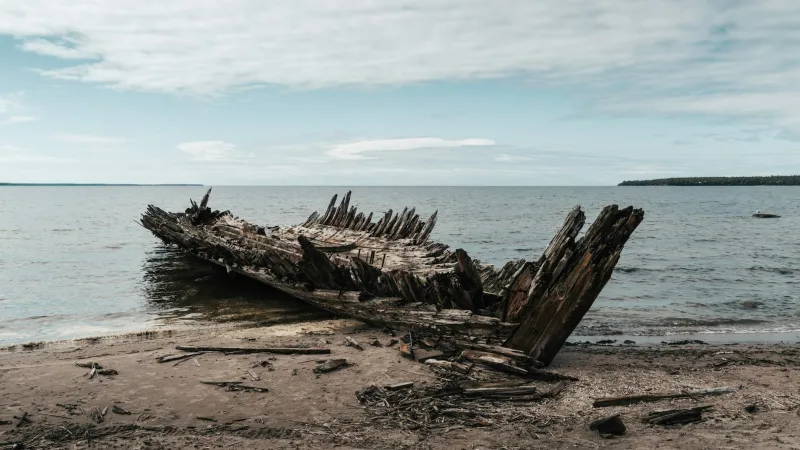
On a foggy October morning in 1851, something extraordinary washed up on the Oregon coast near what is now Lincoln County. It wasn't driftwood or seaweed — it was a half-conscious Spanish sailor named Juan Domingo, the sole survivor of a merchant vessel that had been torn apart by Pacific storms three days earlier.
Domingo was barely alive. Dehydrated, delirious, and speaking rapid Spanish to anyone who would listen, he kept pointing toward the ocean and repeating what sounded like "los otros" — the others. Local settlers Thomas and Mary Caldwell, who had been beachcombing for useful debris from recent storms, found him collapsed near a tide pool.
What happened next would accidentally create one of Oregon's most unlikely towns.
The Rescue That Became Permanent
The Caldwells faced a dilemma. The nearest doctor was a three-day ride inland, and Domingo clearly couldn't travel. So they did what frontier families did best: they improvised. Thomas built a temporary shelter on the beach using salvaged ship timber, while Mary nursed the delirious sailor back to health with whatever remedies she could muster.
Word of the shipwreck survivor spread along the sparsely populated coast. Within a week, curious neighbors began arriving to help — and to hear Domingo's story. The problem was, Domingo spoke almost no English, and none of the settlers spoke Spanish.
So they stayed. And stayed. And stayed.
What started as a temporary rescue mission evolved into something nobody had planned: Oregon's most accidental community.
The Translation That Took Two Years
Domingo's recovery became a group project that consumed the entire winter. Local families took turns bringing food and supplies to the beach camp. Someone always needed to stay with the patient, who remained confused and often agitated. The temporary shelter grew into a more permanent cabin, then two cabins, then a small cluster of buildings.
The breakthrough came in spring 1852, when a traveling Methodist minister named Reverend Samuel Morrison arrived. Morrison had spent time in California and spoke passable Spanish. For the first time in months, someone could actually communicate with Domingo.
The story that emerged was both heartbreaking and remarkable. Domingo had been sailing from San Francisco to Seattle with a cargo of mining equipment when storms drove his ship onto hidden rocks. He'd watched seventeen fellow sailors drown before managing to lash himself to a piece of the mast. He'd drifted for three days, drinking rainwater and eating raw fish when he could catch them.
But here's the twist: Domingo had no family waiting for him, no job to return to, and no money for passage back to Spain. He was, essentially, a man without a country who had literally washed up on America's doorstep.
The Settlement Nobody Planned
By summer 1852, the beach camp had evolved into something resembling a permanent settlement. The Caldwells had decided they liked coastal living better than their inland farm. Other families had built seasonal cabins for fishing and clamming. A small trading post emerged to serve travelers along the coast.
And at the center of it all was Juan Domingo, who had learned enough English to serve as the settlement's unofficial ambassador to passing ships and coastal tribes. His near-death experience had given him a unique perspective on life that seemed to calm disputes and bring people together.
When Oregon Territory officials conducted their 1853 census, they were surprised to discover a thriving community of forty-seven people in a location that hadn't existed on any previous maps. The settlement had grown so organically that nobody had bothered to give it an official name.
The census taker, somewhat bewildered, simply wrote "Domingo Beach" on his forms.
From Accident to Institution
What makes this story truly remarkable is how a series of small, reasonable decisions created something nobody had intended. Each choice — to help a stranger, to stay another week, to build a more permanent shelter — made perfect sense in isolation. But together, they accidentally founded a town.
Domingo himself became the settlement's most beloved resident. He married a widow named Catherine Mills in 1854 and opened a small inn that catered to coastal travelers. His shipwreck story became the stuff of local legend, told and retold around fireplace gatherings.
By 1860, Domingo Beach had a post office, a school, and a small church. The town that nobody planned had become a permanent fixture on Oregon's coast.
The Legacy of Accidental Urbanization
Juan Domingo lived to see his accidental hometown grow into a proper municipality. He served on the city council for fifteen years and was instrumental in convincing the state to build a lighthouse on the dangerous rocks that had claimed his first ship. He died in 1889 at age 73, surrounded by a community that existed only because strangers had refused to let him die alone on a beach.
Today, Domingo Beach (population 2,847) is a popular tourist destination known for its historic lighthouse, charming bed-and-breakfasts, and annual Shipwreck Festival. A bronze statue of Juan Domingo stands in the town square, looking out toward the ocean that nearly killed him but ultimately gave him a new life.
The plaque beneath the statue tells the whole unlikely story, ending with a line that captures the essence of American opportunity: "Sometimes the best destinations are the ones you never meant to reach."
The Town That Proves Anything Is Possible
Domingo Beach represents something uniquely American: the idea that community can emerge from the most unlikely circumstances. A shipwreck, a language barrier, and a group of strangers who refused to abandon someone in need accidentally created a place that has thrived for more than 170 years.
The next time you drive through a small town and wonder how it got there, remember Juan Domingo. Sometimes the most enduring communities are the ones nobody planned to build.