She Didn't Type It. The Machine Did. And Then the Murder Happened.
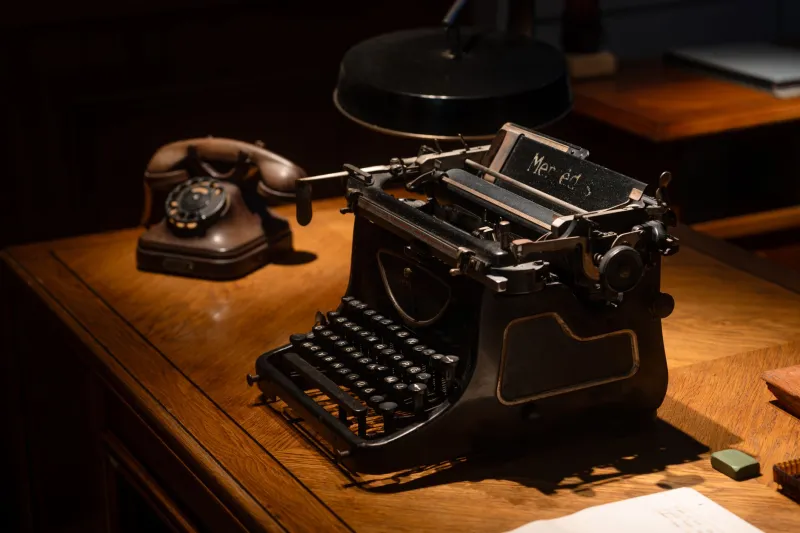
If someone told you their typewriter had started sending them warnings about an upcoming crime, you'd probably suggest they get some rest. Maybe switch to decaf. You definitely wouldn't file a police report on the machine's behalf.
But in a quiet Connecticut town in the mid-1950s, that's almost exactly what happened — and the strangest part isn't the typewriter. It's what came after.
A Machine With Something to Say
The woman at the center of this story — identified in local records and subsequent reporting only by her initials, consistent with how the case was handled at the time — was a clerical worker and part-time typist who owned a standard Underwood typewriter, the kind that sat in half the home offices in postwar America. Nothing exotic. Nothing experimental.
Sometime in the spring of 1953, she began noticing pages in her typewriter that she hadn't produced. Short, fragmented lines. Names. A location. A phrase that, read plainly, described a violent act that would take place near a specific road outside of town.
She showed the pages to her husband. She showed them to a neighbor. Both suggested the obvious explanations — she'd typed them herself and forgotten, or she was confusing drafts from other work. She was insistent that she had not.
She went to the local police. The desk officer recorded her visit but, according to the log that survived in the town's archive, filed it under a category that translates generously as "disturbance, no action required."
Days later, a man was killed near the road she had described.
What the Investigation Actually Found
The case that followed — the actual homicide investigation — brought her back to the attention of authorities, this time with considerably more urgency. Detectives reviewed the pages she had preserved. A typewriter technician from Hartford was brought in to examine the machine.
What the technician found was legitimately strange, even stripped of any supernatural framing. The Underwood had a worn escapement mechanism — the internal part that controls letter spacing and carriage movement. Under specific conditions of humidity and pressure, the machine could, theoretically, produce partial impressions of previously struck keys. This was documented. It was real.
But here's where the explanation starts to fray at the edges: producing random letter impressions is one thing. Producing coherent sentences containing a specific location and a description of a future event is another. The technician noted this discrepancy in his own report. He confirmed the mechanical anomaly. He did not confirm that it explained the content.
The homicide itself was eventually solved — an unrelated dispute between two men with no connection to the woman or her typewriter. The machine was not evidence. It was a footnote.
Why the Story Almost Disappeared
This is where things get quietly interesting in a way that has nothing to do with the paranormal.
In the mid-1950s, law enforcement agencies — particularly at the local level — were not enthusiastic about documentation that made them look credulous. A police log that showed officers had been warned about a murder by a woman citing her typewriter was not the kind of record anyone was eager to preserve. The original incident report was removed from the active file. The technician's written assessment was stored separately, in a box of miscellaneous case materials, where a local historian discovered it in the late 1990s while cataloging donated town records.
The historian — a retired schoolteacher named Gerald Foss, according to his 2001 self-published account of Connecticut oddities — pieced the timeline together from the technician's notes, the police log, and a brief mention in a local newspaper that had covered the homicide without connecting it to the earlier report.
Foss was careful. He didn't claim the typewriter was haunted. He didn't claim the woman had psychic abilities. What he claimed was simpler and, in some ways, harder to dismiss: the documented record showed that a woman reported a specific event before it occurred, that a mechanical examination produced an incomplete explanation, and that the institutional response was to quietly make the whole thing harder to find.
What It Actually Tells Us
The typewriter story is remarkable not because it proves anything supernatural — it doesn't, and it shouldn't be read that way. What it actually illustrates is something more human and more universal.
When an event doesn't fit a comfortable category, the instinct is to file it somewhere inconvenient and move on. The police did it. The technician hedged. The newspaper didn't connect the dots. A retired schoolteacher in the 1990s had to do the archival work that nobody wanted to do in 1953.
The machine itself — if Foss's account is accurate — produced something that looked like a warning. Whether that was mechanical accident, unconscious human behavior, or something that genuinely resists explanation depends entirely on what you're willing to sit with.
What's verified is simpler: a woman reported something strange. Something strange then happened. And the people responsible for keeping records did their level best to make sure you'd never hear about either one.
The typewriter, for its part, was sold at an estate sale sometime in the early 1960s. Its current whereabouts are unknown.
Which honestly feels about right.