For 55 Years, the Speed Limit Law That Made Outlaws of Almost Every American Driver

If you drove a car in America between 1974 and 1995 and you ever pushed past 55 miles per hour — which, statistically speaking, you almost certainly did — there's a genuinely interesting legal argument that the ticket you might have received existed in a constitutional gray zone so murky that even the government preferred not to look too closely at it.
This isn't a conspiracy theory. It's a quirk of rushed legislation, federalism, and the very particular way American law sometimes operates: not by being airtight, but by counting on everyone agreeing not to pull the thread.
The Oil Crisis and the Hasty Law
To understand what happened, you have to go back to the winter of 1973. The Arab oil embargo had sent fuel prices through the roof and created gas lines stretching around city blocks. Congress, under enormous pressure to do something visible and immediate, passed the Emergency Highway Energy Conservation Act in January 1974.
The centerpiece of the law was a national maximum speed limit of 55 miles per hour — a figure chosen because studies suggested vehicles operated most fuel-efficiently at that speed. The idea was straightforward: slow everyone down, burn less gas, reduce dependence on foreign oil.
The execution, however, was where things got constitutionally complicated.
The Problem with Telling States What to Do
Here's the structural issue: under the Tenth Amendment, the federal government has no direct authority to set state speed limits. Roads — with the exception of certain federal highways — fall under state jurisdiction. Congress knew this. So instead of directly mandating a 55 mph limit, the law used a workaround that had become standard practice: it tied federal highway funding to state compliance.
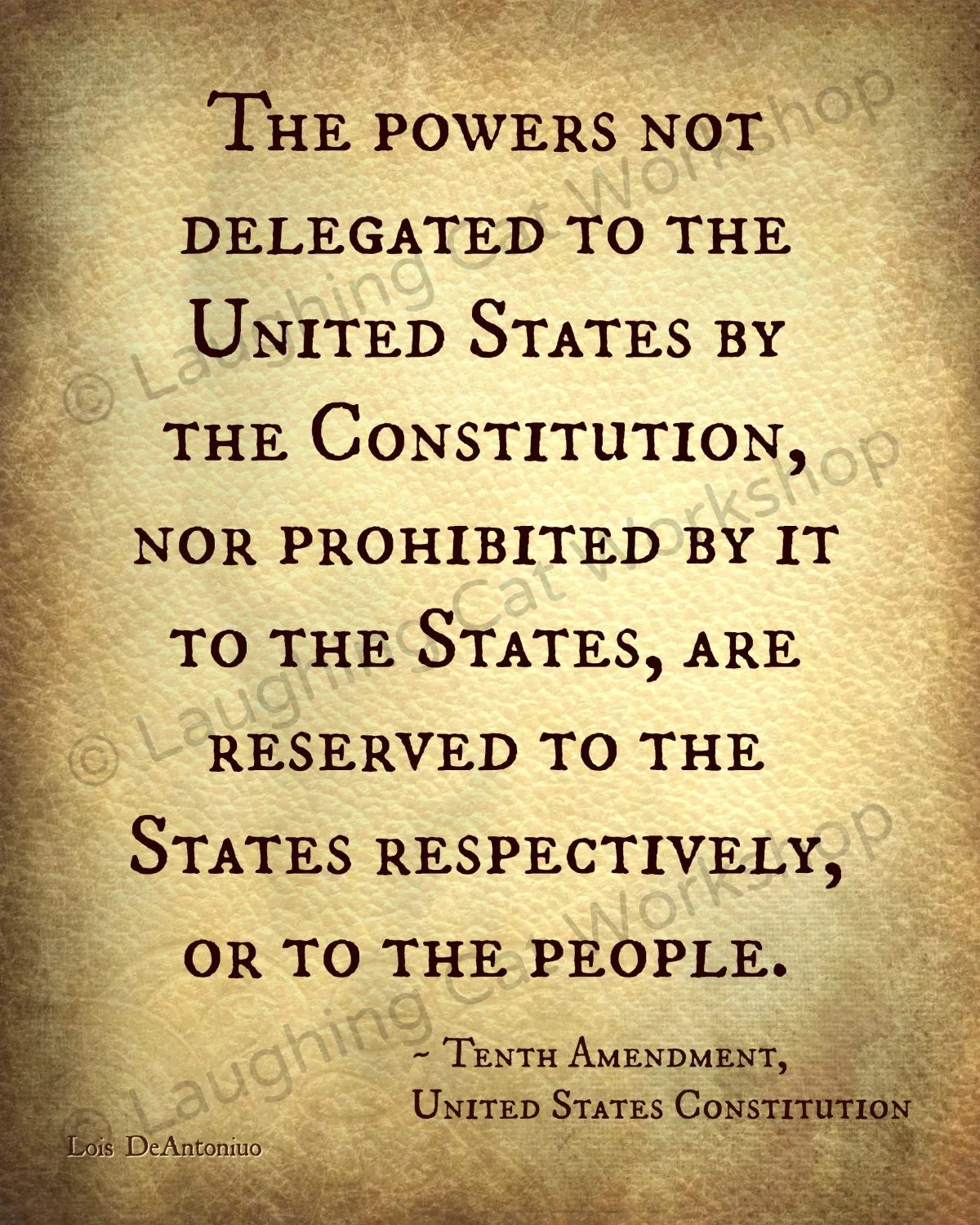 Photo: Tenth Amendment, via i.etsystatic.com
In plain English: states that refused to enforce the 55 mph limit would lose their federal highway dollars. Since no state could realistically afford to walk away from that funding, every state fell in line. The system worked, in a practical sense.
But the drafting of the law left something important unresolved. The legislation established the speed limit as a federal standard and created the funding mechanism to enforce compliance — but it never clearly defined the federal government's independent legal authority to mandate the limit in the first place. The constitutional justification was implied rather than stated. And in law, implied is a very different thing from established.
The Loophole That Traffic Lawyers Loved
For most Americans, this was invisible. You got a speeding ticket, you paid it or contested it on standard grounds — radar calibration, officer positioning, that kind of thing. The constitutional question never came up in traffic court.
But for a small, persistent community of traffic attorneys — particularly in western states where long, empty highways made 55 mph feel like a genuine hardship and enforcement was a significant revenue source — the drafting gap was worth exploring.
The argument, in its most developed form, went roughly like this: the federal government had conditioned funding on state enforcement, but the states were technically enforcing their own laws, which they had passed under federal pressure. The tickets were issued under state authority. But the underlying standard — 55 mph — had been imposed by federal policy without a clear constitutional basis for that imposition. If the federal mandate was on shaky ground, what exactly were the states enforcing?
It wasn't a slam-dunk argument. Courts didn't uniformly accept it, and most judges declined to wade into the federalism thicket when a simpler ruling was available. But in enough jurisdictions, enough of the time, the argument created enough uncertainty that prosecutors sometimes preferred to reduce charges rather than risk an uncomfortable ruling.
The Government's Quiet Decision to Leave It Alone
What's most revealing about this episode isn't the legal argument itself — it's the fact that Congress never fixed the drafting problem. The National Maximum Speed Law stayed on the books, with its constitutional ambiguity intact, from 1974 until its repeal in 1995. Twenty-one years. Dozens of Congresses. Countless legal challenges.
The most plausible explanation isn't oversight. It's that fixing the language would have required openly debating whether the federal government had the authority it had been quietly claiming all along — and that was a conversation nobody particularly wanted to have on the record.
Acknowledging the gap would have invited broader challenges. Leaving it alone allowed the system to function on the collective understanding that everyone would behave as if the law were unambiguous, even when lawyers in conference rooms knew it wasn't.
The Repeal and What It Settled (Which Wasn't Much)
In 1995, Congress repealed the National Maximum Speed Law, returning full authority over speed limits to individual states. Montana briefly flirted with having no daytime speed limit at all on rural highways before settling on 75 mph. Other states went to 80 and beyond.
The repeal resolved the practical problem. It did not resolve the constitutional question, because the question was never officially adjudicated. It simply became moot — which is a very American way of handling a legal problem. Don't answer it. Outlast it.
The Bigger Picture
What this story really illustrates is something that legal scholars have noted for decades: a significant portion of American law operates not on precise legal certainty but on consensus agreement not to challenge it. The 55 mph law worked because states needed the money, drivers mostly complied, and courts were disinclined to create chaos by questioning the foundation.
The moment that consensus frays — the moment enough lawyers, judges, or legislators decide to pull the thread — the whole thing becomes surprisingly fragile.
For 21 years, every American who drove 56 miles per hour on a federal highway was, in at least one defensible legal reading, operating in a space where the government's authority to stop them was less airtight than the officer writing the ticket would ever admit.
Most people never knew. The system preferred it that way.