A Dead Man's Bridge: The Pennsylvania Deed That County Officials Have Been Pretending Not to See for 130 Years
Photo: Neil Owen , CC BY-SA 2.0, via Wikimedia Commons
A Dead Man's Bridge: The Pennsylvania Deed That County Officials Have Been Pretending Not to See for 130 Years
Somewhere in rural Pennsylvania, there is a covered bridge that belongs to a dead man. Not in a poetic sense — not as a metaphor for legacy or memory or the enduring mark a person leaves on a landscape. In a strictly, frustratingly, almost impressively literal legal sense, the deed for a stretch of Pennsylvania infrastructure is recorded under the name of a farmer who died in 1887 and has not, to anyone's knowledge, updated his mailing address since.
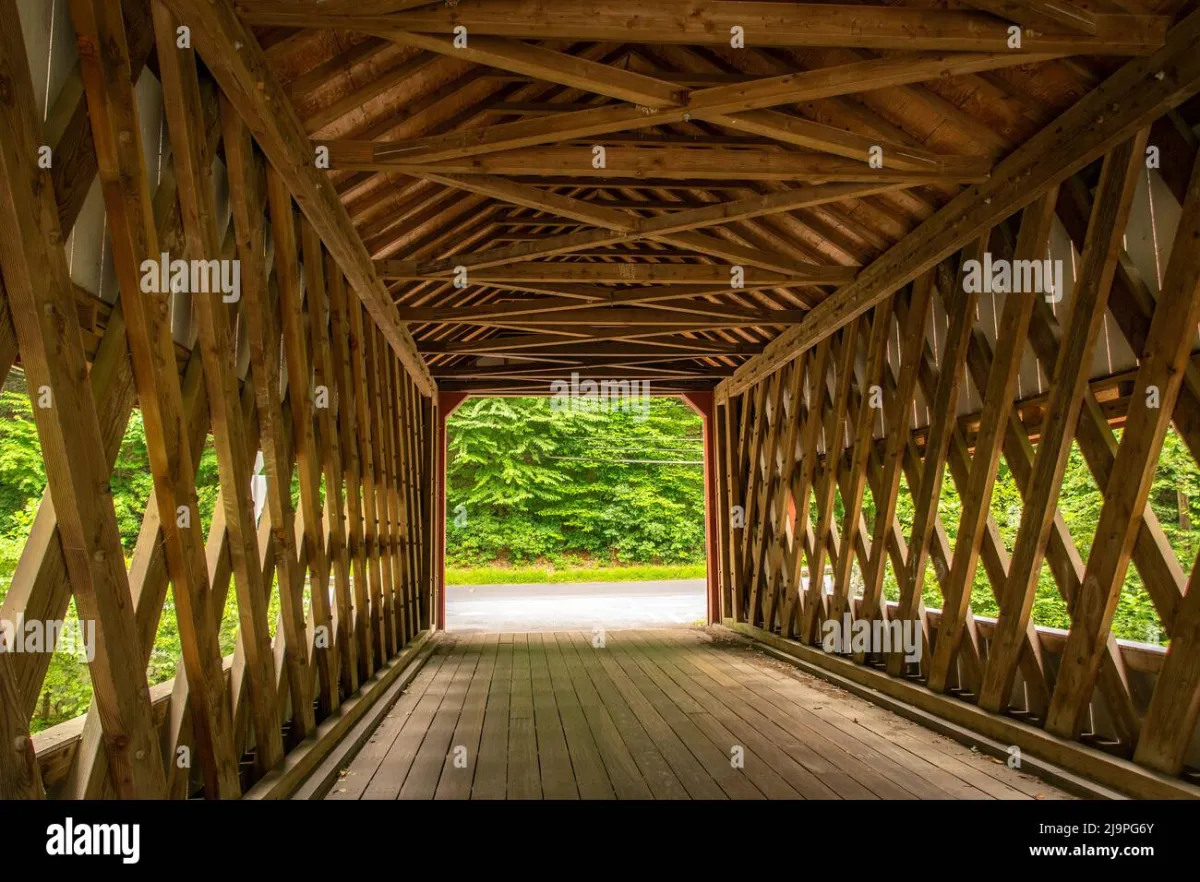 Photo: covered bridge, via c8.alamy.com
The county knows. It has known for a long time. And in a testament to the remarkable human capacity for leaving complicated problems entirely alone, very little has been done about it.
How a Deed Goes Wrong
To understand the tangle, you need to understand how property transfers worked in rural 19th-century Pennsylvania. Land records were kept by hand, in ledgers maintained at the county courthouse. Transfers were recorded by clerks who were working quickly, often with imperfect information, and occasionally with handwriting that future generations would describe charitably as expressive.
When the bridge in question was built — or more precisely, when the land and structure associated with it changed hands in the latter half of the 1800s — a deed was recorded that contained an error. The exact nature of the error has been reconstructed by local historians and county records researchers over the years, and the most widely accepted account goes something like this: the intended recipient of the deed was either a different person entirely or a legal entity that was never properly established. The name that ended up in the ledger belonged to a local farmer — a real man, a documented resident of the county — who had no apparent involvement in the transaction.
The farmer died in 1887. The deed stayed where it was.
Surviving Everything That Should Have Caught It
What makes this story genuinely remarkable is not that the error happened. Errors happen. What is remarkable is the number of times the error should have been caught and wasn't.
Land surveys in the following decades touched the surrounding property without flagging the discrepancy in the bridge deed. County audits reviewed the records and moved on. At some point in the early 20th century, a road improvement project required documentation of adjacent land ownership, and the dead farmer's name apparently appeared in the relevant paperwork without triggering any formal response.
This is not as improbable as it sounds, and that's perhaps the most unsettling part. Property records systems are built to record and retrieve, not to interrogate. A name in a ledger is a name in a ledger. If nobody is challenging it, the system has no particular mechanism for challenging it on its own. The dead farmer's claim to the bridge was never disputed because the bridge was a bridge — it didn't generate revenue, it didn't produce a tax liability that needed to be assigned to a living person, and it didn't require the consent of its owner to function as a bridge.
It just sat there, spanning its creek, belonging to nobody who could sign anything.
The Art of Institutional Avoidance
At some point in the 20th century, county officials became aware that the deed situation was, to put it diplomatically, irregular. The bridge had by then achieved a degree of local landmark status — covered bridges in rural Pennsylvania carry a certain nostalgic weight — and any formal examination of its legal standing would eventually surface the dead farmer's name.
The response, according to researchers who have reviewed the county's handling of the matter, was essentially to develop a very sophisticated institutional shrug. The bridge was maintained. It was included in county infrastructure inventories. It was photographed for tourism materials. What it was not, apparently, was subjected to any formal legal proceeding that would require someone to resolve the deed question.
This is not pure negligence. There is a logic to it, even if it's not a particularly admirable one. Resolving the deed would require establishing who the rightful heir or successor owner should be — a process that, for a transfer error dating to the 19th century, would involve genealogical research, potential legal challenges from multiple parties, court filings, and the kind of sustained bureaucratic effort that county offices with limited budgets tend to view as a very low priority.
The bridge works. Nobody is fighting over it. Why poke the beehive?
What It Would Actually Take to Fix It
Legal experts who have looked at cases like this — and they are not as rare as you might hope — describe the resolution process as genuinely complicated. In Pennsylvania, clearing a defective deed of this age would likely require a quiet title action, a court proceeding in which a judge formally determines the rightful owner and issues an order that supersedes the erroneous recorded deed.
That process requires identifying all potential claimants, which in this case means tracing the descendants of both the erroneously named farmer and whoever the intended recipient of the original deed was — assuming that can even be determined from 19th-century records. It requires legal representation, filing fees, court time, and the attention of a judge.
For a covered bridge in rural Pennsylvania that functions perfectly well and generates no revenue, the cost-benefit calculation is not flattering.
The Ghost in the Ledger
There is something almost companionable about the dead farmer's continued presence in the county records. He never asked for the bridge. He probably never knew it was his. And yet for more than 130 years, his name has persisted in the official documentation, a quiet anomaly in a ledger that nobody has quite gotten around to correcting.
He is, in a sense, the most patient property owner in Pennsylvania history. He has never complained about maintenance schedules, never disputed a survey, never filed a single piece of paperwork. He is, by any measure, an ideal deed holder.
The county, for its part, seems to have quietly made peace with the arrangement. The bridge stands. The creek flows underneath it. And somewhere in a courthouse ledger, a farmer who died before the automobile was invented remains, technically, the owner of a piece of infrastructure that thousands of people have crossed without ever knowing whose bridge they were walking on.